ॐ
About Lord Jagannath Sanskriti
Preserving the eternal culture of Lord Jagannath for all of humanity
Born from Devotion,
Built for the World
Lord Jagannath Sanskriti was born from a simple recognition: that the profound, transformative culture surrounding Lord Jagannath — one of India's most ancient and beloved deities — was at risk of being diluted in the digital age. Our founders, devotees and scholars from the Odia diaspora, set out to change that.
Over seventeen years, we have grown from a small community newsletter into a comprehensive digital platform that archives sacred literature, hosts cultural events, produces devotional media, and connects thousands of Jagannath devotees across the United States, India, and beyond.
Our platform stands as a testament to the power of community — every article, every bhajan, every piece of Pattachitra art uploaded by our members is an act of preservation, an offering to the Lord, and a gift to the generations who follow.

17+
Years of Service
Who Is Lord Jagannath?
Jagannath — Jagat (universe) + Nath (master) — the Lord of the Universe, worshipped for thousands of years as the supreme cosmic deity
“Lord Jagannath is the supreme lord of the universe. He is beyond caste, beyond gender, beyond the limits of form. All are equal before him — the king and the beggar receive the same sacred prasad, the same divine grace.”
— Ancient Skanda Purana
Lord of the Universe
Jagannath is a form of Lord Vishnu or Krishna, worshipped primarily in Puri, Odisha, India. Unlike other Hindu deities depicted in detailed sculptural forms, Jagannath is represented by a uniquely abstract wooden image with large, circular eyes — a form considered to be Brahman (the infinite) manifesting in the finite world.
A Radical Philosophy
Jagannath was perhaps the earliest deity to declare all humans equal before God. The Puri temple was among the first religious sites in India to offer its sacred food — Mahaprasad — to devotees of all castes and classes. This revolutionary inclusivity made Jagannath a symbol of universal brotherhood that transcends every social boundary.
The Puri Jagannath Temple
One of the four sacred Char Dham pilgrimage sites, the Jagannath Temple of Puri was constructed in the 12th century by King Anantavarman Chodaganga of the Eastern Ganga dynasty. The soaring 65-meter tower dominates the Puri skyline and is visible for miles. The temple kitchen feeds over 10,000 pilgrims daily — considered the largest in the world.
Nabakalebara: Renewal of Form
Every 12 to 19 years, the wooden idols of the Sacred Trinity are ceremonially replaced in a profound ritual called Nabakalebara (“new body”). Special sacred Neem trees (Daru Brahma) are identified and carved into the new forms. The ceremony powerfully symbolizes the soul's transmigration — the eternal spirit dwelling in ever-renewing form.
The Sacred Trinity
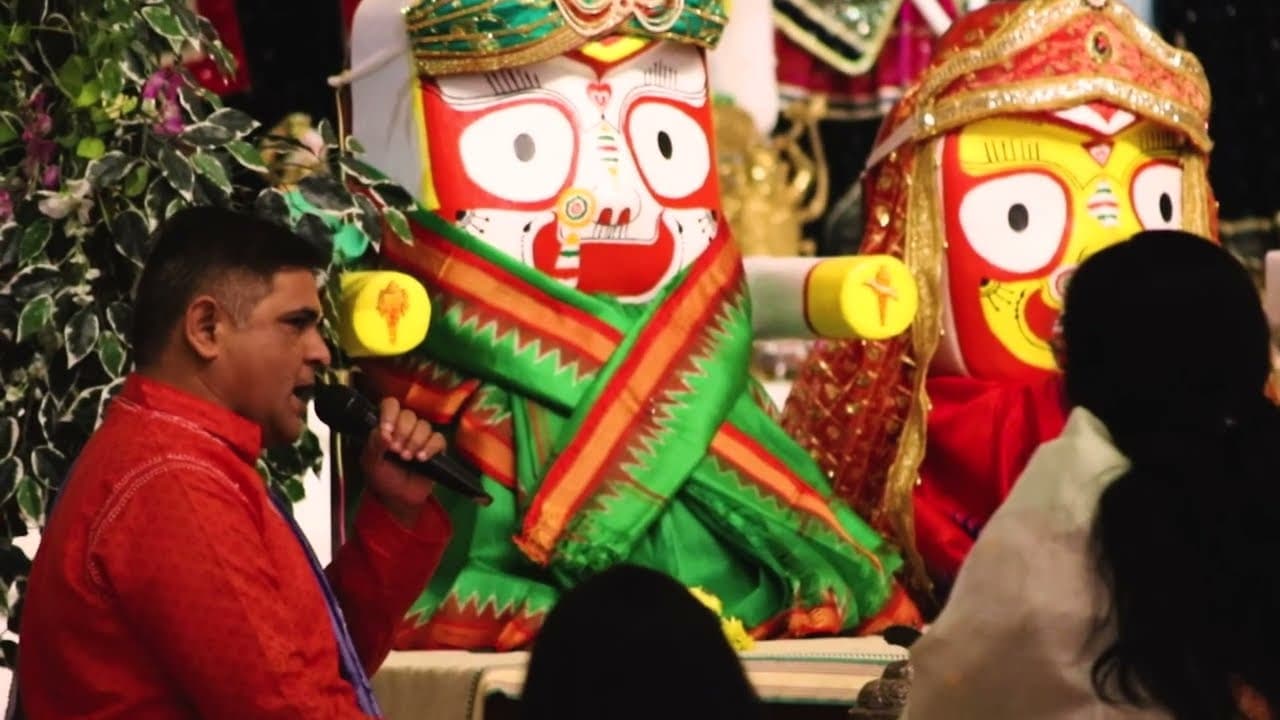
Jagannath is never worshipped alone. He is always accompanied by his elder brother Balabhadra and his sister Subhadra — together they form the Divine Triad.
Jagannath
Lord of the Universe
The principal deity — a form of Vishnu/Krishna. His dark complexion represents the infinite cosmos. His large, round, all-seeing eyes behold the entire universe simultaneously.
Balabhadra
Elder Brother
The elder brother of Jagannath, embodying purity and strength. Balabhadra is associated with righteousness and protection, worshipped as Shiva in some traditions.
Subhadra
Sacred Sister
The beloved sister of Jagannath and Balabhadra, representing Shakti — divine feminine energy. Her golden complexion radiates warmth, compassion, and cosmic power.
Ratha Yatra 2026
July 18–24 • Tampa, FL & Worldwide
Ratha Yatra: When the
Lord Takes to the Streets
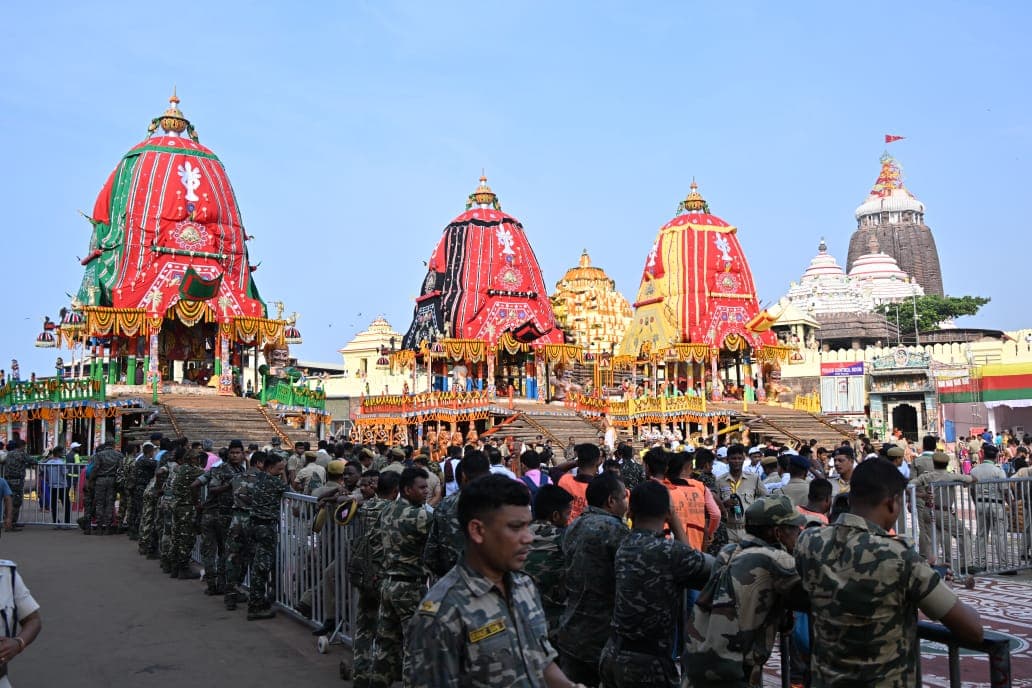
Ratha Yatra — the Chariot Festival — is perhaps the most spectacular festival in the Hindu world. Every year in Puri, the three massive wooden chariots of Jagannath, Balabhadra, and Subhadra are built fresh, decorated with cloth and flowers, and pulled through the city by hundreds of thousands of devoted hands.
The three chariots are named Nandighosa (Jagannath's), Taladhwaja (Balabhadra's), and Darpadalana (Subhadra's). Pulling the chariot ropes is considered an act of supreme spiritual merit — even touching the ropes is believed to wash away lifetimes of karma.
The festival originated in Puri over 2,000 years ago and is now celebrated on every continent. Cities from London to San Francisco to Sydney see the Lord travel through their streets each year.
The Richness of Odia Heritage
Odisha — the land of Lord Jagannath — is home to a dazzling array of classical arts, spiritual traditions, and cultural achievements spanning three millennia
Odissi Dance
One of eight classical Indian dance forms, Odissi originated in the temples of Odisha — particularly the Jagannath temple in Puri. Its fluid movements and expressive gestures narrate the stories of Lord Jagannath and Radha-Krishna. Odissi received UNESCO recognition and is today performed worldwide.
Pattachitra Painting
Pattachitra — from "patta" (cloth) and "chitra" (picture) — is a centuries-old tradition of scroll painting depicting Jagannath, Radha-Krishna, and episodes from Hindu mythology. Practiced primarily in Raghurajpur village near Puri, it is painted with natural pigments and embellished with fine line work.
Mahaprasad
The sacred food offered to Lord Jagannath and distributed to all devotees is called Mahaprasad. The temple kitchen in Puri is the largest in the world, feeding thousands daily. Mahaprasad has no social hierarchy — a king and a sweeper receive the same sacred food, side by side.
Sambalpuri Weaving
Sambalpuri sarees from western Odisha are renowned for their Bandhani (tie-dye) and Ikat weaving techniques. These textiles often depict temple motifs, lotuses, chakras, and scenes from Jagannath lore — an integral part of Odia cultural identity and festival attire.
Our Mission & Values
Five core values guide everything we do — from the content we create to the communities we build
Devotion
Bhakti — heartfelt devotion — is our foundation. We honor Lord Jagannath not through ritual alone, but through a living love that permeates every action and creation.
Inclusivity
Lord Jagannath welcomes all. His temple was the first in India to offer sacred prasad to devotees regardless of caste or creed. We carry this radical equality forward.
Education
Wisdom must be shared to live. Through programs, publications, workshops, and digital media, we keep the ancient knowledge of Jagannath philosophy alive and accessible.
Preservation
We are custodians of Odia culture — its manuscripts, music, dance, painting, and ritual. Every archive we build is a gift to generations yet to come.
Service
Seva — selfless service — is the highest form of worship. We serve our community, our culture, and the mission of Lord Jagannath through every initiative we undertake.
What We Offer
A comprehensive ecosystem for Jagannath devotees, Odia culture enthusiasts, and spiritual seekers
Literature Archive
Thousands of Odia texts, translations, scholarly essays, and sacred scriptures — freely accessible.
ExploreVideo Library
Documentaries, lecture series, festival recordings, and Odissi performances from acclaimed artists.
ExploreCreative Corner
A gallery of community artwork, Pattachitra, poetry, and creative expression inspired by Lord Jagannath.
ExploreEvent Coverage
Comprehensive coverage of Ratha Yatra, Bahuda Jatra, Diwali, and Jagannath cultural festivals worldwide.
ExploreCommunity Forum
An open forum for devotees, scholars, and seekers to discuss, learn, and connect across the globe.
ExploreProject Surya
Our flagship digital preservation initiative — digitizing rare manuscripts and temple records.
ExploreEditors & Contributors
Devoted scholars, artists, and cultural workers who keep the flame of Jagannath culture alive
Suresh Mishra
Founder & Chief Editor
Priya Nanda
Cultural Director
Deepak Mohanty
Literature Curator
Ananya Ray
Community Manager